Fleet Plus / Project guide
Agent Observer
Read-only Codex state for dashboards, diagnostics and agent utilities. Observe the native runtime where it lives, then choose a local or cross-host read path.
Useful facts, with their limits intact
Agent Observer supplies stable session identities, runtime/activity observations, coverage and independently expiring evidence. A consumer can distinguish useful current observations from partial, stale or unavailable state. It does not infer that a missing session is idle or that a disconnected source has no work.
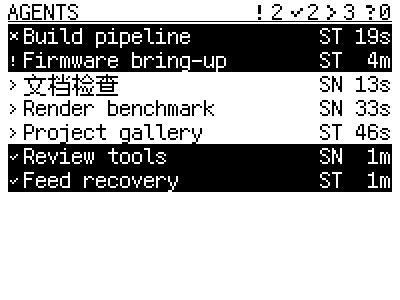
The RLCD agent dashboard is an existing consumer. It chooses its own rows and presentation, consumes public observations and owns the hardware protocol. Other read-only utilities can use the same public boundaries without depending on that display.
Follow an observation
Interactive explanation · fictional example
From native runtime to utility.
The native runtime owns the conversation. Observer supplies read-only facts; each utility chooses its own display.
A separately running Observer service publishes host-local facts. Your utility reads that cache; reading does not start a daemon or renew native evidence.
Read all three cases
Local clients read an explicitly hosted cache. Fleet clients add optional Mesh delivery through configured routes. Missing, incomplete or expired evidence remains uncertain; it cannot establish idle work, removal or an empty working set.
These controls explain the architecture. They do not contact a runtime or change a configuration.
Choose a read path
| Interface | Use |
|---|---|
| Direct host snapshot | Explicit inspection against the existing owning daemon |
| Local cached Service 4 | Read-only clients of an independently hosted collector/service |
| Working-set reads | Admitted active membership plus recent context; the reviewed default window is 72 hours |
| Full diagnostic feed | Fuller explicit inventories and diagnostic consumers |
Core/local hosting stays independent of Mesh. Optional Mesh adds configured cross-host delivery. A window, terminal or tmux pane is not the authority for native conversation runtime state. Codex's owning daemon supplies that evidence.
Start using it
Follow your first local Observer read: install the published core in its own environment, choose an existing Codex home, read local state and understand the table. Requires Linux, Python 3.11+ and your existing native Codex runtime. Mesh, Rofi and tmux are unnecessary for this path.
For shared cached observations, use the current Service 4 guide. It covers an existing endpoint or a separately owned foreground publisher, cached reads, watching and cleanup. Fleet delivery is an optional next step after the local read works, with compatible Mesh, publishers and directional host routes.
For a utility, use the bounded public-read example and API 4 contract. The example supplies a content-free diagnostic summary; it is a developer example, not a new daemon, wire contract or installed product.
Current scope
Codex is the only implemented native observation adapter. Claude monitoring, Observer writes and standalone active-only delivery are retired. Working-set retains active membership; native provider tools own conversation control.
Agent Plus independently opens native Codex/Claude TUIs and does not depend on Observer. Codex Plus provides separate native workflow augmentations. Neither relationship grants Observer action authority.
The compatibility guide records the published working-set pair, independent consumer versions and dated operational limits. Experimental transport adoption retains its own explicit selection and qualification.