Fleet Plus / Shared guide
How the projects fit together
Native Codex and Claude managers own their conversations and work. Fleet Plus's projects supply observation, host access and independent desktop conveniences.
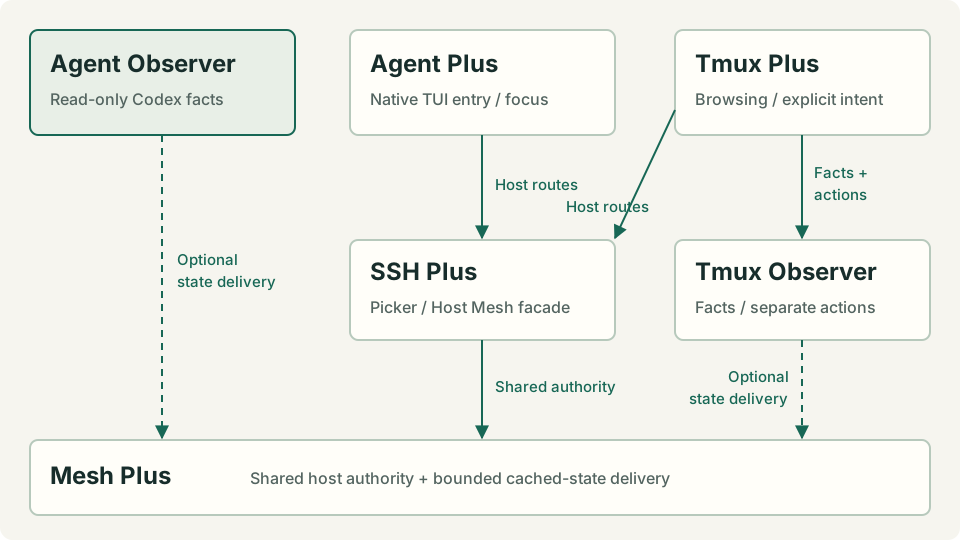
Arrows show interface use; dashed arrows are optional delivery. This diagram describes project relationships. Configured host access has its own direction.
Four responsibilities
| Responsibility | Projects | Boundary |
|---|---|---|
| Read-only agent facts | Agent Observer | Codex identity, runtime/activity, freshness and coverage |
| Host access and state delivery | Mesh Plus + SSH Plus | Logical hosts/routes, SSH entry and bounded cached delivery |
| Native agent entry | Agent Plus | Environment inventory and owned TUI window launch/focus |
| Generic tmux tooling | Tmux Observer + Tmux Plus | Native tmux facts, prepared views, browsing and explicit actions |
Agent Observer's core/local service remains Mesh-free. Optional Mesh carries already published observations through pure profiles. Mesh supplies delivery validity; it does not classify agent work or collect from a provider.
Agent Plus consumes Host Mesh routes through SSH Plus's public interface. It has its own host helper and native-window registry. It does not consume Observer conversation state or depend on Tmux. Claude entry there is independent of Observer's retired Claude monitoring.
Tmux Plus uses its exact Tmux Observer counterpart. The Observer owns native facts and prepared composition; a separate action client validates explicit lifecycle intent. Agent Observer's write retirement does not retire tmux actions.
Directional host access
Mesh owns the host/route implementation. SSH Plus retains the public Host Mesh process facade and its own successful-connection history. They use one selected authority rather than maintaining competing host registries.
Directional routing · fictional hosts
A route has a direction.
Desk can reach Tower and Laptop. Tower and Laptop can reach each other. Neither has a route back to Desk.
Desk → Tower · Desk → Laptop
Desk can read both peers. Neither peer has a configured route back to Desk.
Arrows mean “can initiate access to.” This illustrates configured membership, not a full mesh or live reachability.
Removing a host from one endpoint's roster withdraws that endpoint's configured access. Cached discovery must respect that membership. An existing native window is independently owned and does not grant a route to a removed host.
Observation is not delivery liveness
Agent Observer reports evidence with independent coverage and freshness. Mesh can prove that a cached source remains available without renewing the underlying native observation. Utilities preserve that distinction when displaying state.
Working-set reads include admitted active membership and recent context. Full diagnostic reads retain their own route. A partial membership census is not a complete empty set. Expired or unavailable evidence cannot establish idle, parked, removed or completed work.
Repositories and ownership
Each component owns its code, public contracts, reference docs, artifacts and acceptance evidence. Fleet Plus owns the shared presentation and explanations. Managed manifests stay with the deployment owner. The six projects retain independent release versions; the compatibility overview links to evidence for particular combinations.
The repository and presentation decision records why this shared site preserves independent projects.
Codex Plus supplies workers, watches, peer coordination and browser reports around native Codex. It is related work, with an independent runtime and distribution owner. Hardware dashboards likewise retain their own UI, selection, device protocol and physical acceptance.
Experimental work
The retained semantic delta engine is dark and stopped after failed CPU/capacity gates. The separate complete-view feed and optional WSS transport have explicit selection/qualification boundaries. Their existence in source or a package does not select them for ordinary configured readers.